A washing bay that stays busy on and off throughout the day puts different demands on equipment than a single car wash at home, and this is where the protection features built into a high pressure washer start to matter more than the headline pressure figure on the spec sheet. Buyers comparing units by max pressure alone often overlook the features that determine whether the machine survives daily commercial use without an operator watching it constantly. A high pressure washer that looks identical to a competitor's unit on paper can behave very differently once it runs through weeks of unattended operation in a busy bay.
A high pressure washer left running without an active spray, whether from an operator stepping away or a hose kink stopping flow, builds heat and pressure inside the pump that shortens component life over repeated occurrences. An automatic cutoff after a set idle period, commonly around 60 minutes of no active use, removes the need for constant supervision while protecting the motor from the kind of prolonged no-load running that gradually damages seals and bearings. Buyers running unattended or semi-attended washing bays should treat this feature as close to essential rather than optional, since the alternative is relying entirely on operator discipline to shut the machine off manually.
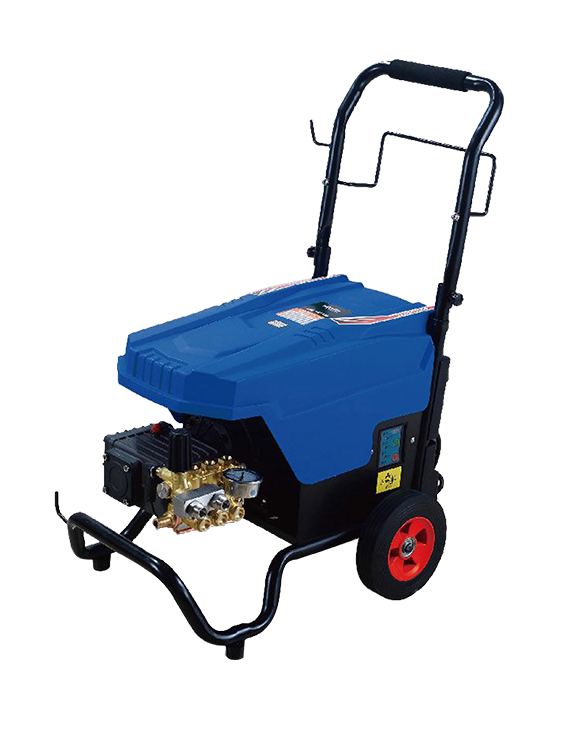
Leakage protection on a high pressure washer addresses the electrical risk created by water and electricity operating in proximity, cutting power automatically if current leaks outside its intended path rather than waiting for a fuse or breaker further upstream to react. Overload protection works differently, monitoring motor current draw and cutting power before sustained excess load damages windings, which matters especially during startup or when the machine works against a partially blocked nozzle. Buyers should confirm both protections are present as separate systems rather than assuming one covers the other, since they respond to different failure conditions.
The motor inside a well-built high pressure washer typically uses a four-pole aluminum housing design, chosen for its balance of running speed, torque delivery, and heat dissipation through the metal housing during extended operation. Aluminum housing sheds heat more effectively than lighter plastic alternatives, which becomes relevant specifically in commercial settings where the unit may run for hours across a full working day rather than the shorter cycles typical of home use. A motor rated with a multi-year guarantee against phase-loss failure gives buyers a concrete benchmark to compare across suppliers rather than relying on a general durability claim.
A stainless steel plunger with a sprayed porcelain surface and heat treatment resists the wear that comes from constant high-pressure cycling far better than untreated metal alternatives, since this component experiences more repeated mechanical stress than almost any other part in the pump assembly. Buyers sourcing for heavy daily use should ask specifically about plunger material and treatment process, since this detail rarely appears prominently on a basic spec sheet but has an outsized effect on how often the pump needs servicing.
|
Model Class |
Motor Power |
Max Pressure |
Typical Application |
|
Entry commercial |
2.2kw, 220V |
Around 1450 psi |
Mobile and family car washing |
|
Mid commercial |
3kw, 380V |
Around 1740 psi |
Small car park operations |
|
Heavy commercial |
4kw, 380V |
Around 2465 psi |
Higher-volume washing bays |
A high pressure washer is only as reliable as the match between motor output and the pump model paired with it, since an undersized pump run against a stronger motor wastes potential output while an oversized pump strains a weaker motor beyond its rated capacity. Buyers assembling custom configurations rather than ordering a pre-matched unit should confirm the specific pump model recommended for their chosen motor rating, since mismatched pairings are a common source of underperformance that traces back to a sourcing decision rather than a manufacturing defect. Suppliers who publish a clear motor-to-pump matching chart, rather than leaving buyers to guess at compatible combinations, make this part of the sourcing process considerably easier to get right from the outset.
Zhengmao is an export enterprise specializing in the production, service and development of pneumatic tools.
 English
 中文简体
中文简体 Deutsch
 Español
 Français
 русский
 عربى
عربى